William Whyte was a sociologist whose studies came to include public spaces in American cities, especially plazas and parks here in New York City. Most of his work isn’t directly applicable to the rallies and marches we organize, but the combination of observation and attempting to predict which interventions will improve people’s experience does have some familiar echoes.
Whyte’s research is documented in a book and film, which is preserved in several different versions shown in the years of the late 1970s and early 1980s. One version of the film is on Daily Motion, and the book is at the Internet Archive (free account required to read).
There’s an unusual and confusing situation that can happen in a large crowd downstream of a pinch point. I had experienced it before without really understanding what was going on, but then got a good view of it at No Kings 2, and then again at another event in January.
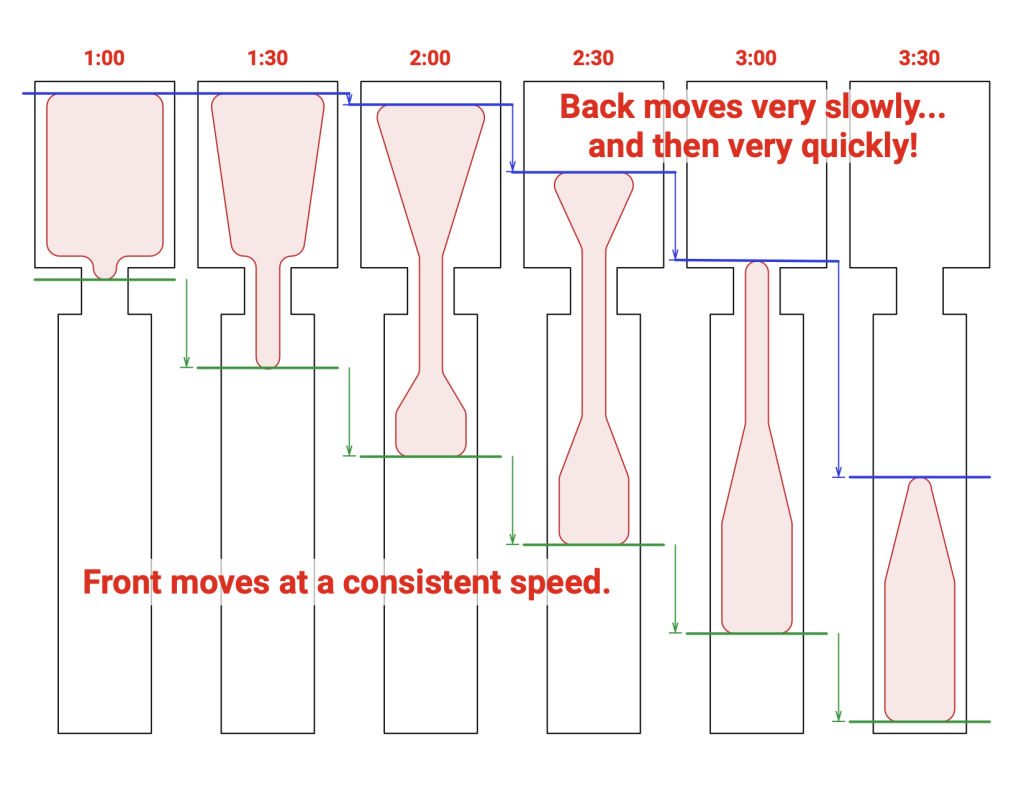
Below is a cartoon of the No Kings 2 march leaving Times Square, or a similar situation. The front moves through the pinch point and proceeds down the route at a consistent pace. Meanwhile the back doesn’t move at all for a while, then moves slowly, then gets through the pinch point and suddenly is moving uncomfortably fast.
For example, at No Kings 2, the front line took 100 minutes to get from 42nd to 14th (a slow 0.9 miles per hour), but the back line was stationary for a long time… and then abruptly covered that same distance in 50 minutes (a fast 1.8 miles per hour) — it seems like a paradox, but it really happened!
Sometimes (especially at smaller marches) problems with pacing in the back are purely a factor of the front line moving too quickly, but I have recently observed situations like the above, where the back might feel like the front was moving too fast, but in fact the front pacing was exactly what we would have asked — it’s just that the combination of the pinch point and the wider route downstream meant that the back was moving very fast and we don’t have any way of slowing it down, because in these gigantic marches, once the front banners reach the end of the route, we no longer have any way to set the pace for the middle of the crowd.
My goal for No Kings 3 is to try to help manage the pacing in the middle of the march by introducing a few “middle lines” (the Broadway banners, held in Times Square and re-inserted later, plus the giant artwork contingent) which have their own (smaller) team of marshals helping them set a consistent pace.